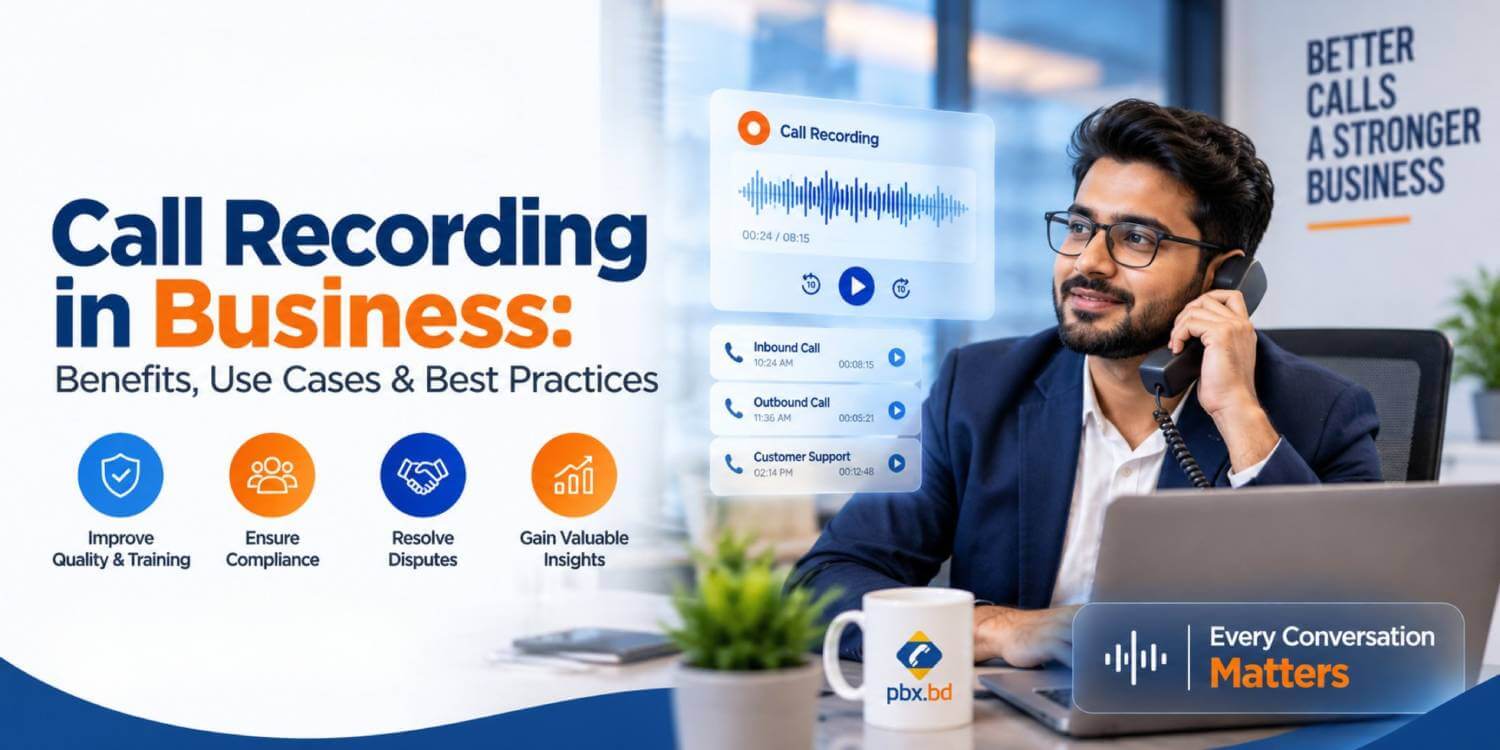
What Is Call Recording in Business?
Every customer conversation contains valuable information.
A sales call may reveal what a potential customer is looking for. A customer support call may highlight a recurring problem. An important business conversation may also contain details that need to be reviewed later.
This is where Call Recording in Business becomes useful.
Business Call Recording allows organizations to record incoming and outgoing voice conversations for authorized business purposes.
Depending on the Business Phone System, calls can be recorded automatically or based on specific organizational requirements.
With a modern Cloud PBX Call Recording solution, businesses can maintain better visibility over customer conversations while supporting service quality, staff training, and operational accountability.
Why Is Call Recording Important for Businesses?
Phone communication remains important for sales teams, customer service departments, call centers, corporate offices, and service-based businesses.
However, depending only on memory or manually written notes can lead to missing information.
A professional Call Recording System provides businesses with a reliable communication reference that authorized team members can review whenever necessary.
Business call recording can help organizations:
- Improve customer service quality
- Review important customer conversations
- Train employees more effectively
- Monitor communication standards
- Resolve misunderstandings
- Understand customer requirements
- Identify recurring customer concerns
- Improve internal accountability
For businesses that handle a large number of customer calls, Call Monitoring and recording can become an important part of communication management.
Key Benefits of Call Recording in Business
1. Improve Customer Service Quality
Customer experience depends heavily on how professionally a business communicates.
With Customer Service Call Recording, managers can review selected customer conversations and better understand how calls are being handled.
Businesses can evaluate:
- Agent communication quality
- Accuracy of information
- Customer handling skills
- Common customer complaints
- Response quality
- Overall customer experience
This helps organizations identify areas where customer service can be improved.
2. Make Employee Training More Effective
Traditional training may not cover every real-life customer situation.
Recorded calls provide practical examples of actual customer conversations.
Businesses can use selected recordings to train employees on:
- Professional greetings
- Product explanations
- Handling customer objections
- Complaint management
- Effective questioning
- Problem-solving
- Call closing techniques
A Business Call Recording system can therefore become an important part of continuous employee development.
3. Improve Quality Monitoring
Maintaining consistent communication standards becomes more difficult as a business grows.
With Call Monitoring, supervisors can periodically review conversations and evaluate whether employees are following company communication guidelines.
This can help businesses maintain consistency across:
- Sales teams
- Customer support teams
- Different branches
- Multiple departments
- Different work shifts
Better monitoring can lead to better service quality.
4. Reduce Miscommunication
Business phone conversations may include important discussions about:
- Pricing
- Service requirements
- Technical details
- Order information
- Delivery schedules
- Customer requests
Later, the customer and employee may remember the conversation differently.
When authorized personnel have access to a relevant call recording, they can review what was discussed.
This makes Call Recording in Business useful for reducing communication-related misunderstandings.
5. Understand Customer Needs Better
Customer calls can provide valuable business insights.
By reviewing recurring questions and conversations, businesses may identify:
- Frequently requested services
- Common product questions
- Customer pain points
- Service improvement opportunities
- Common objections
- Repeated support issues
These insights can help sales, marketing, product, and customer service teams make better decisions.
6. Improve Sales Performance
Sales calls contain valuable information about customer behavior.
Using Sales Call Recording, managers can evaluate how sales representatives:
- Introduce products or services
- Understand customer requirements
- Respond to objections
- Explain pricing
- Present product benefits
- Follow up with prospects
- Handle sales conversations
Strong sales calls can also be used as training examples for other team members.
This creates a structured process for improving sales performance.
7. Maintain Better Business Records
Some business conversations may need to be referenced later.
For example, customers may discuss:
- Service requirements
- Technical specifications
- Order details
- Support instructions
- Appointment information
- Account-related requests
A properly managed Call Recording System provides an additional reference for reviewing important communication when necessary.
Common Use Cases of Business Call Recording
Different departments can benefit from Cloud PBX Call Recording in different ways.
Customer Support Teams
Customer support departments can use recorded calls to understand customer problems, evaluate support quality, and identify recurring issues.
Recordings can also help managers improve agent training and communication standards.
Sales Teams
Sales managers can analyze recorded conversations to understand customer objections and identify opportunities for improvement.
Recordings can help businesses determine:
- Which sales approach works better
- Which questions customers frequently ask
- Which objections occur most often
- How sales representatives communicate value
This can contribute to a more effective sales process.
Call Centers
For call centers, communication quality directly impacts customer satisfaction.
A Call Center Call Recording solution can support:
- Agent performance reviews
- Quality assurance
- Employee training
- Complaint investigation
- Supervisor monitoring
- Customer experience improvement
Call recording is particularly valuable for businesses handling a large number of daily calls.
E-commerce Businesses
E-commerce businesses often receive calls related to:
- Product information
- Order confirmation
- Delivery updates
- Returns
- Customer complaints
- Payment-related questions
Customer Service Call Recording can help teams manage these conversations more clearly and efficiently.
Healthcare and Appointment-Based Organizations
Organizations that manage appointments over the phone can use call records to verify scheduling information and improve communication accuracy.
However, sensitive information should always be handled according to applicable privacy, security, and regulatory requirements.
Financial and Professional Service Businesses
Professional service organizations often discuss important customer requirements over the phone.
When implemented with proper policies and authorization, Business Call Recording can provide a useful reference for important client communication.
Multi-Branch Businesses
Businesses operating multiple offices or branches can use a centralized Cloud PBX System to manage communication more efficiently.
A central system can help organizations maintain consistent communication standards across different locations and departments.
Best Practices for Business Call Recording
Simply enabling call recording is not enough.
Businesses should establish clear policies regarding how recordings are created, accessed, stored, reviewed, and deleted.
1. Inform Call Participants When Required
Businesses should comply with applicable laws, consent requirements, privacy rules, contractual obligations, and industry regulations.
Where notification or consent is required, callers should be appropriately informed that the conversation may be recorded.
2. Define the Purpose of Call Recording
Organizations should clearly determine why they are recording calls.
Common purposes include:
- Quality assurance
- Customer support improvement
- Employee training
- Business documentation
- Complaint management
- Dispute resolution
A clear purpose helps businesses create better call recording policies.
3. Control Access to Recordings
Call recordings may contain confidential customer or business information.
Therefore, recordings should only be accessible to authorized personnel.
Access may be limited to:
- Supervisors
- Department managers
- Quality assurance teams
- Authorized administrators
Unnecessary access should be avoided.
4. Protect Recorded Data
Call Recording Security should be treated as an important part of business communication management.
Organizations should ensure that recordings are stored securely and accessed through properly managed systems.
Businesses should also define rules for:
- Downloading recordings
- Sharing recordings
- Exporting recordings
- Deleting recordings
5. Create a Call Recording Retention Policy
Businesses may not need to keep every call recording permanently.
A clear retention policy should define:
- How long recordings are stored
- Why recordings are retained
- Who can access them
- When they should be deleted
- Whether different call types require different retention periods
Retention policies should follow applicable regulatory and business requirements.
6. Review Calls Regularly
Call recordings become more valuable when businesses actively use them for improvement.
Managers can create a structured quality assurance process and review selected calls regularly.
Important evaluation areas may include:
- Professional communication
- Response accuracy
- Customer handling
- Product knowledge
- Problem-solving
- Call resolution
Regular reviews can help improve overall service quality.
7. Use Recordings for Improvement, Not Only Monitoring
The purpose of Call Recording in Business should go beyond simply monitoring employees.
Recorded conversations can provide valuable insights for improving:
- Customer service
- Employee training
- Sales performance
- Communication processes
- Customer experience
Businesses can use call data to identify patterns and make more informed decisions.
Call Recording with Cloud PBX
Traditional telephone systems can make advanced call management difficult.
A modern Cloud PBX provides businesses with a centralized communication platform.
Depending on the service configuration, businesses can combine Call Recording with features such as:
- IVR
- Multiple Extensions
- Call Forwarding
- Call Transfer
- Call Routing
- Voice Messages
- Call Conferencing
- CRM Integration
- Centralized Call Management
Combining these features can help businesses build a more organized communication system.
Call Recording with bdpbx.com
For organizations looking for a modern PBX Solution in Bangladesh, bdpbx.com provides cloud-based business communication solutions designed for professional call management.
With bdpbx.com Cloud PBX, businesses can use Call Recording together with communication features such as:
- IVR
- Call Forwarding
- Call Routing
- Call Transfer
- Multiple Extensions
- Voice Messages
- Call Conferencing
- CRM Support
A centralized Cloud PBX Bangladesh solution can help businesses manage customer communication more professionally and efficiently.
Whether you operate a:
- Sales department
- Customer support team
- Corporate office
- Call center
- E-commerce business
- Multi-branch organization
bdpbx.com can help create a more structured and professional business communication environment.
Final Thoughts
Customer conversations contain valuable information that businesses can use to improve customer service, employee performance, sales processes, and overall communication.
A properly implemented Call Recording System allows businesses to review important conversations instead of depending entirely on memory or manual notes.
However, businesses should combine Business Call Recording with:
- Clear recording policies
- Proper access control
- Secure data storage
- Regular quality reviews
- Appropriate retention policies
- Applicable privacy and consent requirements
With a professional Business Phone System and Cloud PBX Call Recording, organizations can create a more measurable, accountable, and customer-focused communication process.
Do You Want Better Control Over Your Business Calls?
Choose bdpbx.com Cloud PBX and manage your business communication with powerful features including Call Recording, IVR, Call Routing, Call Forwarding, Call Transfer, Multiple Extensions, and more.
Get Started with bdpbx.com Today. Visit: bdpbx.com
Frequently Asked Questions (FAQ)
Call Recording in Business is the process of recording business phone conversations for authorized purposes such as quality monitoring, employee training, customer service improvement, business documentation, and communication review.
The main benefits of Business Call Recording include improved customer service, better employee training, quality monitoring, easier communication review, improved sales performance, and better understanding of customer requirements.
Yes. A modern Cloud PBX Call Recording system can record incoming and outgoing calls depending on the system configuration. Authorized users can then review relevant recordings whenever required.
Yes. Customer Service Call Recording helps managers evaluate service quality, identify customer issues, and improve employee training. Sales teams can also use recordings to understand customer objections, review sales conversations, and improve communication techniques.
Yes. bdpbx.com Cloud PBX supports Call Recording along with business communication features such as IVR, Call Forwarding, Call Routing, Call Transfer, Multiple Extensions, Voice Messages, Call Conferencing, and CRM Support.
Businesses should configure and use call recording according to applicable privacy, consent, and regulatory requirements.
Share Now