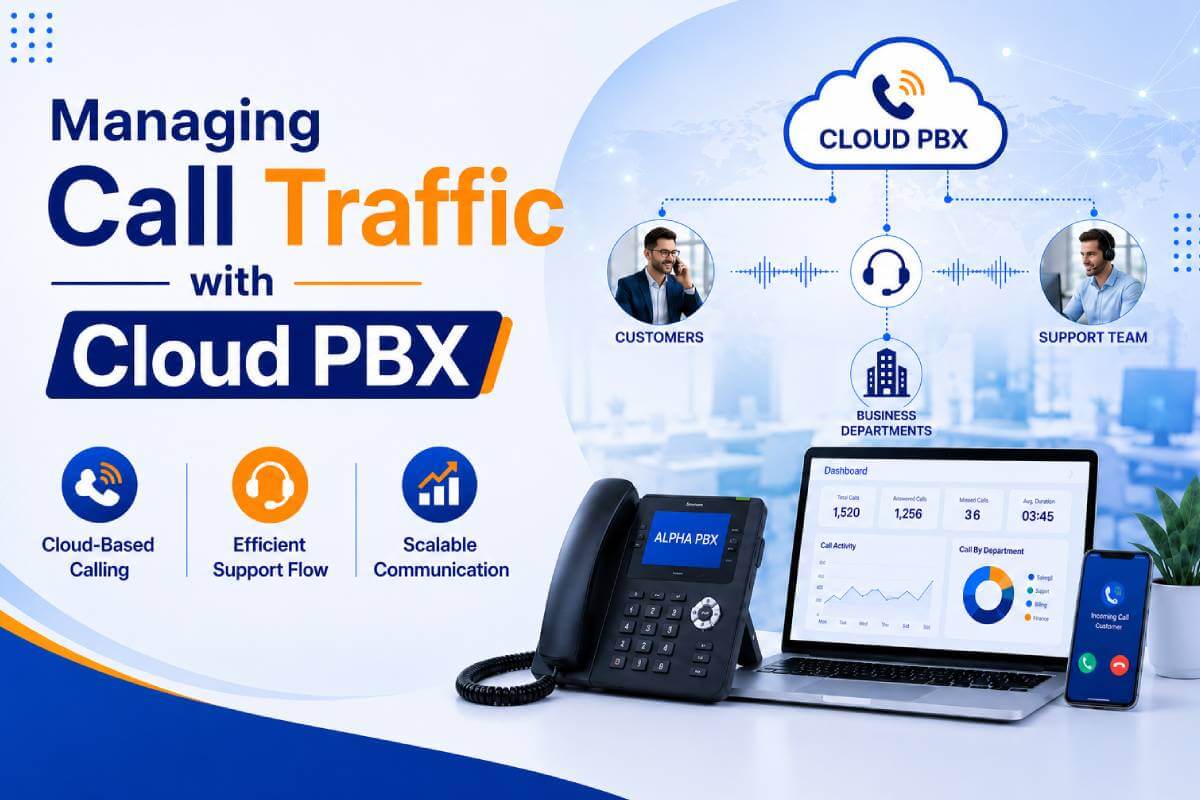
Managing business calls becomes difficult when customer inquiries increase, agents get busy, and calls start coming from different departments or locations. Missed calls, long waiting times, and poor call routing can directly affect customer satisfaction and sales.
A Cloud PBX system helps businesses manage call traffic more efficiently by moving the phone system to the cloud. Instead of depending on traditional on premise PBX systems, companies can use a cloud based PBX to route calls, manage queues, support remote teams, and improve the overall calling experience.
For growing businesses, a modern cloud PBX system is not just a communication tool. It is a smarter way to handle customers, improve team productivity, and reduce unnecessary phone system costs.
What Is Cloud PBX?
Cloud PBX stands for Cloud Private Branch Exchange. It is a business phone system hosted over the internet instead of being installed physically in an office.
With a traditional PBX system, businesses need hardware, wiring, maintenance, and technical support. But with a cloud hosted PBX, most of the system is managed by the service provider. Businesses only need internet-connected devices such as IP phones, mobile apps, softphones, or computers.
A Cloud PBX system usually includes features like:
- Call forwarding
- Call routing
- Auto attendant
- IVR menu
- Call queue
- Voicemail
- Call recording
- Extension management
- Call reports and analytics
This makes cloud PBX solutions useful for small businesses, call centers, sales teams, support teams, and multi-branch companies.
Why Call Traffic Management Matters
Every business call has value. A missed call may mean a missed customer, lost sales opportunity, or poor customer experience.
When call traffic is not managed properly, businesses may face problems such as:
| Call Traffic Problem | Business Impact |
|---|---|
| Missed calls | Lost leads and sales |
| Long wait time | Frustrated customers |
| Wrong department routing | Poor customer experience |
| No call tracking | Difficult to measure performance |
| Limited phone lines | Busy signals and failed calls |
| No remote support | Reduced flexibility |
A Cloud PBX helps solve these issues by organizing incoming and outgoing calls through smart automation.
How Cloud PBX Helps Manage Call Traffic
1. Smart Call Routing
One of the most useful cloud PBX features is intelligent call routing. It sends incoming calls to the right person, department, or location based on your business rules.
For example:
- Sales calls go to the sales team
- Support calls go to customer service
- Billing calls go to the accounts department
- VIP customer calls go to priority agents
This reduces confusion and helps customers reach the right person faster.
A hosted PBX system can also route calls based on time, location, availability, or department. This is especially useful for businesses with multiple branches or remote teams.
2. Auto Attendant for Professional Call Handling
An auto attendant works like a virtual receptionist. It greets callers and gives them menu options.
For example:
“Press 1 for Sales, Press 2 for Support, Press 3 for Billing.”
This makes your business sound more professional and helps customers choose the right department without waiting for a human receptionist.
Benefits of auto attendant include:
- Faster call distribution
- Better customer experience
- Reduced workload for staff
- Professional brand image
- 24/7 call direction
Many hosted PBX providers include auto attendant features in their packages.
3. IVR System for Better Customer Experience
IVR means Interactive Voice Response. It allows callers to interact with your phone system using keypad input or voice commands.
An IVR system is useful when your business receives many calls every day. Instead of manually answering every call, your cloud based PBX can guide callers automatically.
Common IVR uses include:
- Department selection
- Payment information
- Order status
- Support ticket direction
- Business hour information
This saves time for both customers and employees.
4. Call Queue Management
During busy hours, all agents may be occupied. Without a proper system, customers may hear a busy tone or the call may disconnect.
A cloud PBX system solves this with call queues. Callers stay in line until an agent becomes available.
Call queue features may include:
- Hold music
- Queue position announcement
- Estimated wait time
- Priority queue
- Call-back option
- Agent availability tracking
This is very helpful for support teams, sales teams, hospitals, service centers, and call centers.
5. Call Forwarding and Remote Access
Modern businesses no longer work only from one office. Employees may work from home, travel, or manage customers from different branches.
A cloud hosted PBX system allows calls to be forwarded to:
- Mobile phones
- IP phones
- Laptop apps
For example, if a customer calls your office number after business hours, the call can be forwarded to a manager’s mobile phone. This helps reduce missed calls and improves response time.
This is one reason why many businesses search for the best PBX for small business or the best hosted PBX solution.
Cloud PBX vs Traditional PBX
Many businesses still use traditional on premise PBX systems. However, cloud technology offers more flexibility and lower maintenance.
| Feature | Cloud PBX | Traditional PBX |
|---|---|---|
| Setup Cost | Lower | Higher |
| Hardware | Minimal | Requires physical equipment |
| Maintenance | Managed by provider | Managed by business |
| Scalability | Easy to add users | Difficult and costly |
| Remote Access | Yes | Limited |
| Updates | Automatic | Manual |
| Best For | Modern and growing businesses | Fixed office setups |
For most modern companies, a business cloud PBX is easier to manage and more suitable for growth.
Important Cloud PBX Features for Call Traffic
Before choosing a PBX service provider, businesses should check which features are included.
| Feature | Why It Matters |
|---|---|
| Call Routing | Sends calls to the right person |
| IVR | Automates caller selection |
| Call Queue | Manages high call volume |
| Call Recording | Helps with training and quality control |
| Voicemail to Email | Keeps messages accessible |
| Call Analytics | Tracks call performance |
| Mobile App | Supports remote workers |
| CRM Integration | Improves customer management |
The best cloud PBX providers offer a combination of reliability, useful features, easy management, and clear pricing.
Cloud PBX Pricing: What Affects the Cost?
Cloud PBX pricing can vary depending on the number of users, features, call volume, and provider package.
Common pricing factors include:
- Number of extensions
- Local calling
- Call recording storage
- IVR and queue features
- CRM integration
- Mobile app access
- Support level
- Setup and configuration
Here is a simple pricing overview:
| Business Type | Common Requirement |
|---|---|
| Small Business | Few extensions and basic routing |
| Medium Business | IVR, queue, recording, reports |
| Call Center | High call volume and analytics |
| Enterprise | Multi-branch and advanced integration |
When comparing hosted PBX pricing, businesses should not only look at the monthly cost. They should also consider reliability, support quality, features, and scalability.
A cheaper provider may not always be the best option if call quality or support is poor.
Best Practices for Managing Call Traffic with Cloud PBX
1. Create Clear Call Routing Rules
Start by mapping your business departments. Decide where each type of call should go.
For example:
- New customer inquiries → Sales
- Existing customer problems → Support
- Payment issues → Billing
- Business partnership calls → Management
Clear routing reduces confusion and improves response time.
2. Use IVR Carefully
IVR is useful, but too many menu options can frustrate callers. Keep your IVR simple and easy to understand.
Good IVR example:
- Press 1 for Sales
- Press 2 for Support
- Press 3 for Billing
- Press 0 to talk to an agent
Avoid making customers go through too many steps.
3. Monitor Call Reports
A good cloud PBX service should provide call analytics. These reports help you understand how your team handles calls.
Important metrics include:
- Total incoming calls
- Missed calls
- Average waiting time
- Call duration
- Peak calling hours
- Agent performance
By checking these reports, you can improve staffing and customer service.
4. Train Your Team
Technology alone is not enough. Your team should know how to use the system properly.
Train employees on:
- Answering calls professionally
- Transferring calls correctly
- Using voicemail
- Checking call history
- Managing missed calls
- Following up with customers
This helps your business get the full benefit from a hosted PBX phone system.
5. Plan for Growth
Choose a system that can grow with your business. You may need more extensions, departments, or branches in the future.
A scalable pbx cloud system allows you to add users without replacing your entire phone setup.
This is especially important for businesses that are expanding, hiring more staff, or opening new branches.
Who Should Use Cloud PBX?
A virtual PBX system is useful for many types of businesses.
| Business Type | How Cloud PBX Helps |
|---|---|
| Small Business | Professional phone system at lower cost |
| E-commerce | Handles customer support calls |
| Call Center | Manages high call volume |
| Healthcare | Routes patient calls efficiently |
| Real Estate | Forwards calls to agents |
| IT Company | Supports remote and hybrid teams |
| Multi-branch Business | Connects all locations under one system |
For small companies, a virtual PBX for small business can create a professional communication experience without expensive hardware.
How to Choose the Best Cloud PBX Provider
There are many cloud PBX service providers, so choosing the right one is important.
Before selecting a provider, ask these questions:
- Does the provider offer stable call quality?
- Is the system easy to manage?
- Are IVR and call queue features included?
- Is pricing clear and transparent?
- Can the system support remote workers?
- Does the provider offer local support?
- Can the solution scale as the business grows?
The best cloud PBX providers are not always the ones with the most features. The right provider is the one that understands your business needs and offers reliable support.
Cloud PBX for Businesses in Bangladesh
Businesses in Bangladesh are increasingly moving from traditional phone systems to cloud communication. Whether it is a small company, service provider, online store, or support center, better call management is now essential.
A reliable cloud PBX phone system helps Bangladeshi businesses:
- Reduce missed customer calls
- Improve team communication
- Support remote employees
- Manage high call traffic
- Create a professional brand image
- Scale without heavy hardware investment
For businesses that want better control over calls, moving from PBX to cloud can be a smart long-term decision.
Conclusion
Managing call traffic is one of the most important parts of business communication. When calls are missed, delayed, or sent to the wrong person, customers can quickly lose trust. A Cloud PBX system helps businesses solve these problems with smart call routing, IVR, call queues, remote access, and real-time reporting.
Whether you are comparing cloud PBX providers, looking for a hosted PBX service, or planning to upgrade from traditional on premise PBX systems, a cloud solution can make your communication more flexible, professional, and cost-effective.
If your business is ready to manage calls more efficiently, bdpbx.com can help you choose the right solution. With BD PBX, businesses can simplify call routing, reduce missed calls, support remote teams, and deliver a better customer experience.
Looking for a reliable Cloud PBX solution in Bangladesh? Contact bdpbx.com today and discover how BD PBX can improve your business communication.
FAQ
Cloud PBX is an internet-based business phone system that manages calls through the cloud instead of physical office hardware.
Cloud PBX manages call traffic through smart routing, IVR, call queues, forwarding, and real-time call analytics.
Yes, Cloud PBX is ideal for small businesses because it is affordable, scalable, and does not require expensive phone hardware.
Hosted PBX and cloud PBX are often used similarly. Both refer to phone systems hosted by a provider and accessed through the internet.
Cloud PBX cost depends on users, features, call volume, and provider packages. Many providers offer monthly pricing or custom business plans.
Share Now